ITIL Service Management Assessments
In my M.S. course on IT Planning & Service Management Using ITIL, each assignment put me inside a fictional company with real-world IT problems and asked for recommendations to leadership. The companies were invented for the course; the analysis and recommendations below are mine.
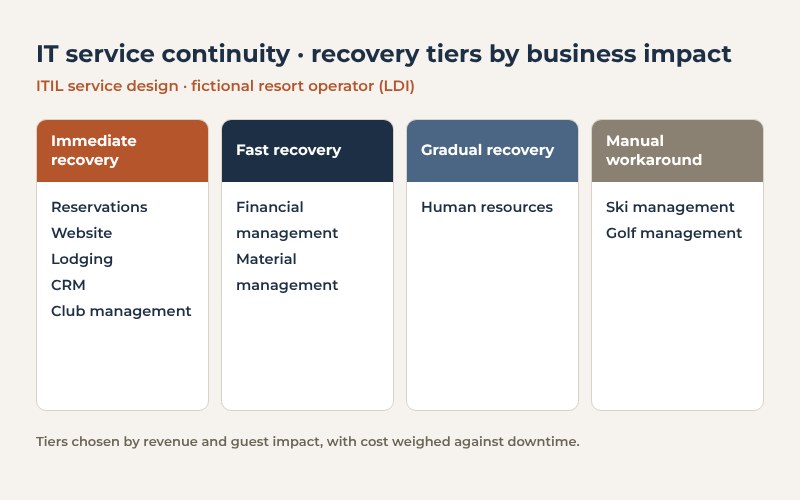
Resort operator: an ITIL roadmap for the VP of IT
A global resort company with no defined list of IT services, weak service levels, and aging systems nobody had retired.
Service portfolio
- Defined the portfolio: a pipeline, a catalog of 12 live services (from the service desk to reservations, lodging, ski, golf, and club management), and a retired list.
- Showed how never retiring services had left legacy systems in place.
Service levels & suppliers
- Replaced unmeasurable SLAs with the full set: service level requirements, measurable SLAs, internal OLAs, and a service improvement plan.
- Specified OLAs with every department, Finance, and HR.
- Identified six outside suppliers that needed underpinning contracts, including 24/7 support for the business-critical website.
Continuity
- Assigned every service a recovery tier based on what an outage would cost the business (below).
| Tier | Services | Why |
|---|---|---|
| Immediate recovery | Reservations, Website, Lodging, Customer relationship management, Club management | Revenue stops the moment these go down. Reservations and the website serve guests across time zones around the clock, and club members are the most loyal customers. |
| Fast recovery | Financial management, Material management | Used by nearly every division, but guests can still check in and stay while they're down. Purchasing still matters: guests notice when the restaurant runs out of something. |
| Gradual recovery | Human resources | Not critical to daily operations, with paper records as a fallback. Restoring from backup is acceptable, and faster options would cost more than the downtime. |
| Manual workaround | Ski management, Golf management | Each resort can take bookings by phone and in a daily planner until the system returns, the way it worked before computers. |
Mobile music service: fix the foundation before expanding
A fast-growing company weighing two new lines of business, a mobile game and a dating app, after a 48-hour outage.
Recommendation
- Advised leadership to hold off on both launches until core IT service management was in place.
- In an earlier memo to leadership, explained what ITSM is and why it would align IT with the business: utility and warranty, clear ownership, and accountability.
Top three risks
- Availability: no formal service levels, and an implied 99.999% target already missed.
- People and legacy tech: a COBOL finance and procurement system, a shrinking talent pool, and falling morale.
- Change management: each office configured differently, no release management, and no known-error database.
Why it still matters
- It's the same judgment I use today: tie IT decisions to business impact, standardize before you scale, and put controls around change.
LDI and Mobile Music are fictional companies created for the course. The case materials belong to their authors and aren't reproduced here.